
| Sithideth Viengkhou
Francois Gagnon Joel Martel Renaud Lavoie |
|
|
In our previous white paper entitled ‘Transparent vs. Boundary clocks (PTP) in the Broadcast Environment, ( https://www.embrionix.com/resource/transparent_boundary_clock_ST2059_in_broadcast ), we offered a ten-thousand foot view of PTP in the broadcast IP environment to introduce the concept of PTP for broadcast engineers, technicians, system integrators and anyone interested in the subject.
Embrionix has deployed ST2110 systems around the world and found a common set of challenges are always present during ST2110 deployments. For this reason, we created a new white paper on the takeaways from our different experiences. As a reminder from the previous PTP white paper, SMPTE uses the PTP as the synchronization mechanism for video, audio and metadata over IP. The AES also uses PTP for AES67 synchronisation. The following figure (Figure.1) shows the typical configuration of a network with PTP.
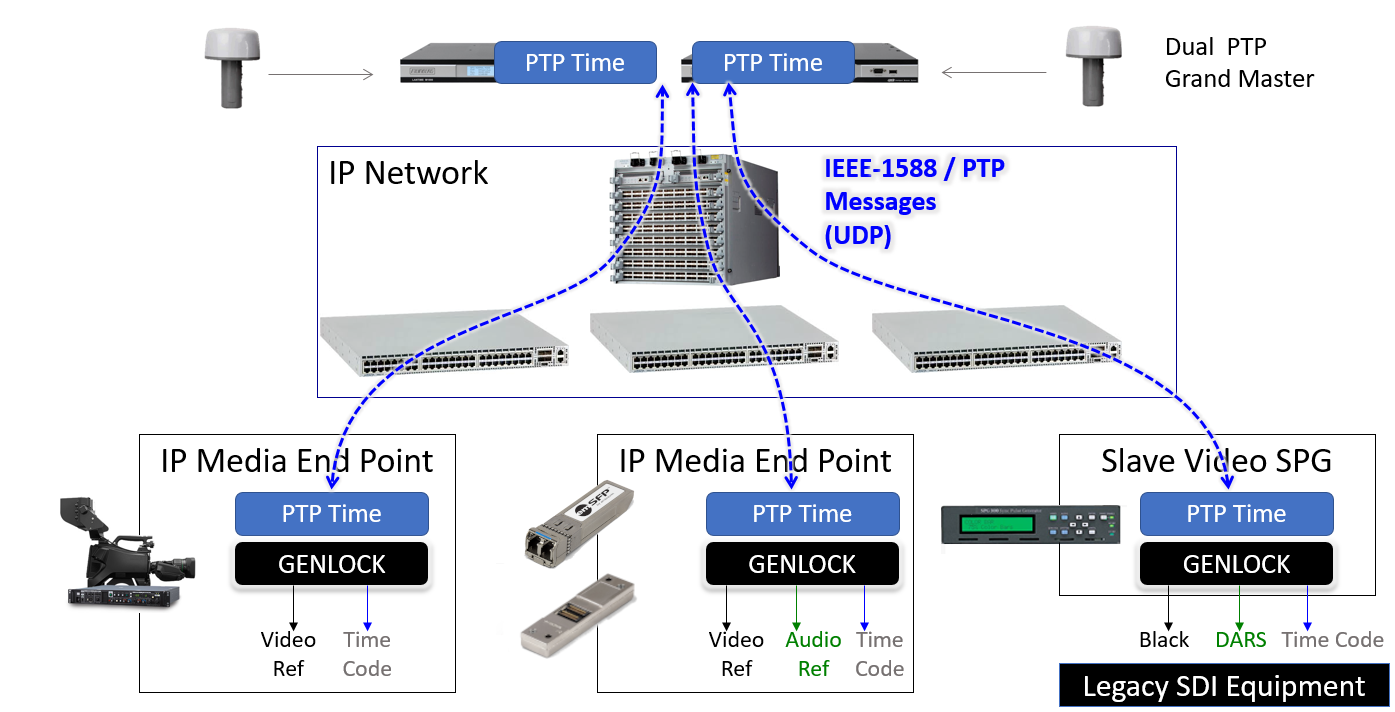
Figure 1. Video and Time Reference in an IP Media Facility (courtesy, Michel Proulx)
TAKEAWAYS FROM DEPLOYMENT
The following sections provide an overview of the key takeaways from our various installations/deployments around the globe. The goal of this document is to highlight some key points that the Embrionix team discovered during deployment in various systems. Our team understands that the ST2110 specification, moving forward, will add more key points and we consider those as equally important as the ones covered in this document. We will do our best effort to keep this document up to date to help our customers avoid roadblocks and pitfalls.
PTP: BACKBONE OF THE ST2110 DEPLOYMENT
One of our team’s most important takeaways: Without a stable and constant PTP, the ST2110 system will not work or will only partially work with glitches on video and pops in the audio. It is preferable that your system has at least one PTP Grandmaster to be considered synchronous in ST2110 specification. The Embrionix team considers the PTP Grandmaster as mandatory for ST2110 deployment, not unlike the black burst as mandatory in an SDI installation.
A key action for SDI studios and installations is to synchronize every incoming feed with the studio’s black burst reference to ensure the vertical blanking is aligned. In ST2110 there is no vertical blanking, however all the ‘0’ pixels should be aligned. This is achieved with PTP and timestamping.
PTP acts in the same way as a black burst reference signal. The major difference when using PTP, compared to a legacy reference signal, resides in the definition of an absolute origin point in time (1970-01-01T00:00:00TAI), defined as SMPTE Epoch. PTP time is zero at Epoch and then starts counting forward up to now. Similarly, a video signal synchronized to PTP would have its VSYNC occur at the SMPTE Epoch and then, at every frame rate increment, up to now.
In a ST2110 system, alignment between video sources and PTP reference is done through a timestamping mechanism. Every field/frame of video is timestamped using the value of the PTP time when its VSYNC (hereafter defined as the alignment point) occurs.
In the case of multiple video streams, timestamps in the packets should all be in sync for the receiver to welcome all synchronized feeds and subsequently allow for desired processing.
Take away: One PTP Grandmaster is mandatory for any ST2110 deployment. Embrionix can guide you in the choice of a PTP Grandmaster.
PTP VS SDI SYNCHRONIZATION
While a PTP system is fundamental in an ST 2110 environment, maintaining synchronization between PTP and the legacy black burst (SDI reference) remains crucial during the transition from SDI infrastructures. Although frame synchronizers can correct free-running SDI inputs, they introduce additional delay.
Because ST 2110 is widely deployed in studio environments where low latency is essential, it is best practice to align SDI inputs with the facility’s reference signal before they reach the gateway. Otherwise, signals must be frame-synchronized to PTP, typically adding up to one frame of delay (as illustrated in Figure 2).
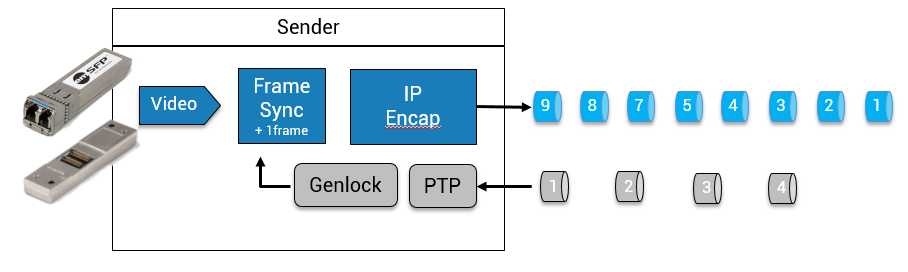
Figure 2. Sender with Frame Sync on PTP
According to SMPTE ST 2059-1, signals should be locked to the PTP Alignment Point (AP). Furthermore, ST 2110-10 defines “synchronous senders” as those aligned to PTP, while “asynchronous senders” are not time-aligned and therefore require frame synchronization either before or within the ST 2110 encapsulation process. In practice, most deployed systems rely on synchronous senders to ensure optimal performance and minimal latency.
Bridging SDI and IP environments introduces challenges, particularly when interfacing equipment that is not Epoch-aware with modern, Epoch-aware timing systems. Legacy signal generators were typically designed to lock to frequency, but not necessarily to phase or a defined Epoch. In contrast, today’s signal and PTP generators—compliant with SMPTE ST 2059-1—are Epoch-aware, ensuring alignment in both frequency and phase.
Figure 3 illustrates the type of offset that can arise between the Alignment Point (AP) and the VSYNC when a legacy studio black burst is not phase-aligned with the SMPTE Epoch.
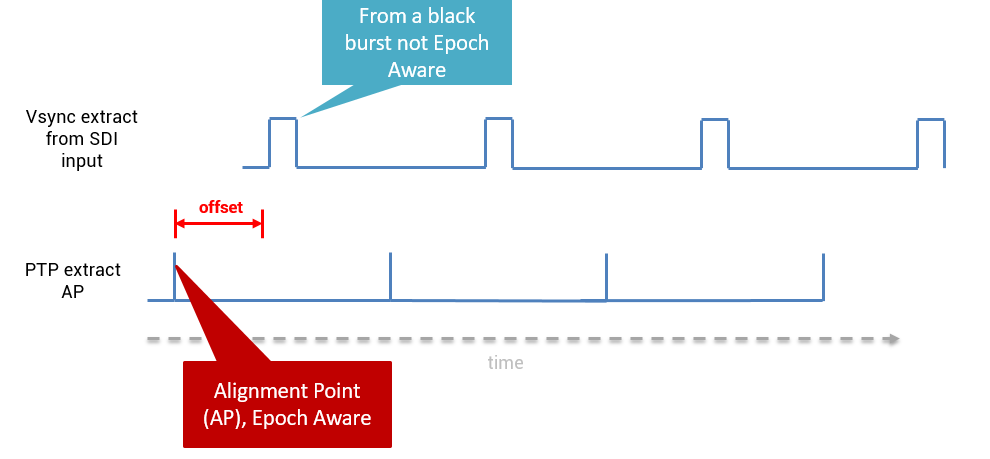
Figure 3. Offset Between Not-Epoch-Aware VSYNC and PTP Alignment Point
Take away: In a ST2110 receiver, there is no provision for adjustable compensation offset. Embrionix products have compensation offset engines to enable you to use non-Epoch-aware signal generators.
PTP VS. MULTI-ESSENCE STREAM SYNCHRONIZATION
When working within an ST 2110 system, SDI essences—such as video, audio, and ANC—are transported separately over IP networks. As a result, a mechanism is needed to accurately recombine these streams when required. This is accomplished through precise packet timestamping, using the PTP Grandmaster as the common time reference. Its clock provides the unified timing basis for generating ST 2110 timestamps across all streams.
When streams are correctly timestamped at the sender, a receiver can reliably realign incoming multi-essence flows, regardless of varying network path delays. This PTP-based realignment is essential for downstream operations, enabling seamless source switching and maintaining proper lip-sync.
Figure 4 illustrates multiple senders transmitting timestamped video-only or video-and-audio essences over different network paths to a single receiver. The receiver buffers each incoming stream and reconstructs them at the output by selecting the appropriate packets—those matching the current PTP time—from each buffer, ensuring accurate synchronization across all essences.
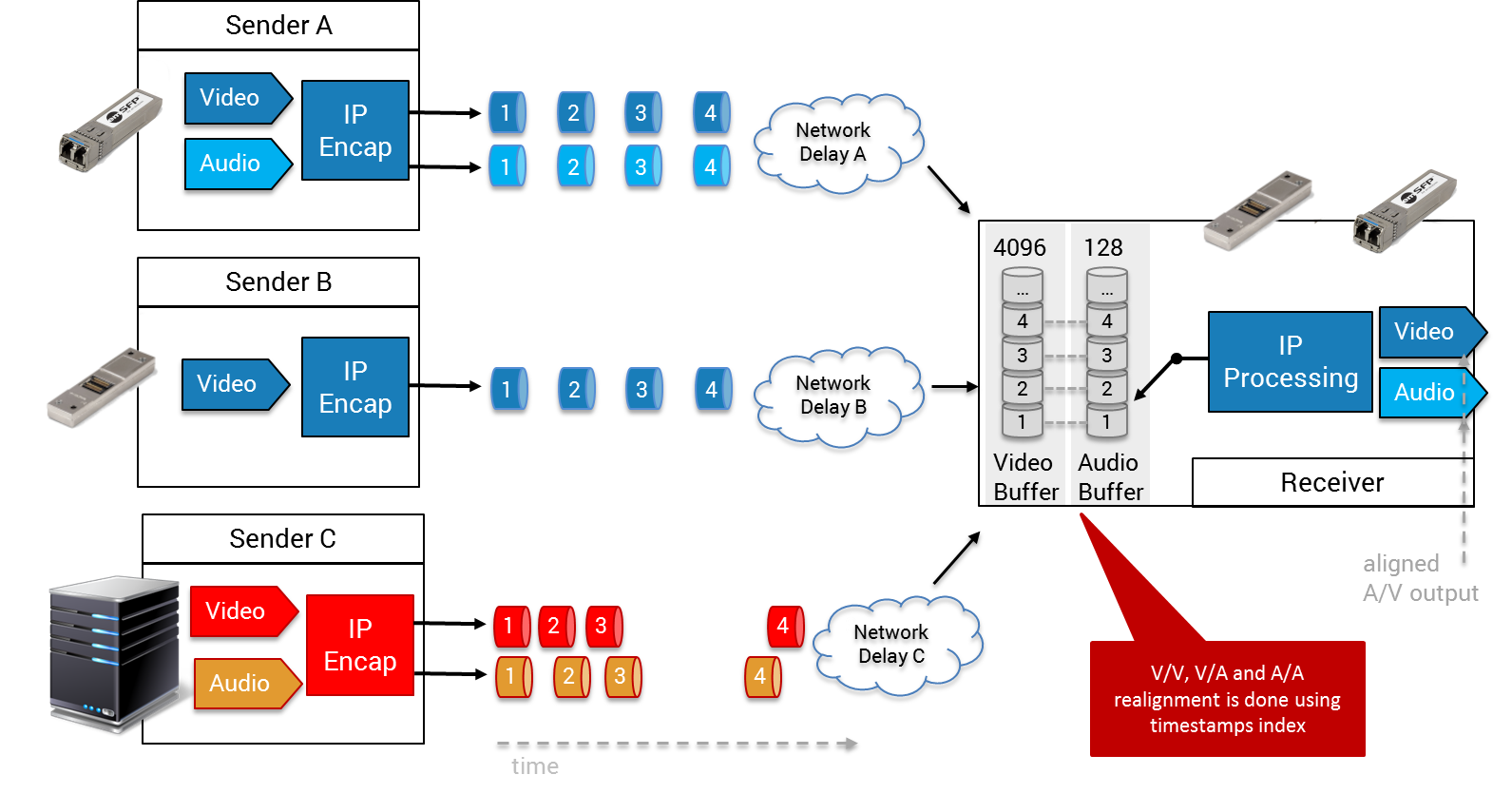
Figure 4. Importance of Packet Timestamping for Realignment
Take away: In an ST 2110 system, a PTP Grandmaster—together with synchronous sources—plays a vital role in ensuring the precise realignment of multiple multi-essence streams. Embrionix receivers incorporate advanced realignment engines that ensure all output essences are accurately synchronized with each other and remain tightly aligned to the PTP reference.
GRANDMASTER, BOUNDARY CLOCK, Time Receiver LOAD
It is important to understand the role of each clock type. Please see the following whitepaper entitled: Transparent Vs Boundary clocks (PTP) in Broadcast Environment by Embrionix that touches on this subject: https://www.embrionix.com/resource/transparent_boundary_clock_ST2059_in_broadcast
UNDERSTANDING THE NETWORK CLOCK TREE
The choice of clock tree architecture directly influences the volume of PTP traffic across the network. In an optimal design, the Grandmaster communicates only with boundary clocks, which in turn act as Time Transmitters for their respective downstream Time Receiver devices.. This simplifies system scaling and makes it easier to expand the overall infrastructure, reduces traffic to the Grandmaster and makes policing of traffic much easier.
In Figure 5., the PTP Grandmaster only sees two (2) Time Receiver clocks. Adding a Time Receiver clock to group A or group B will not impact the Grandmaster. These groups can grow or change as required.
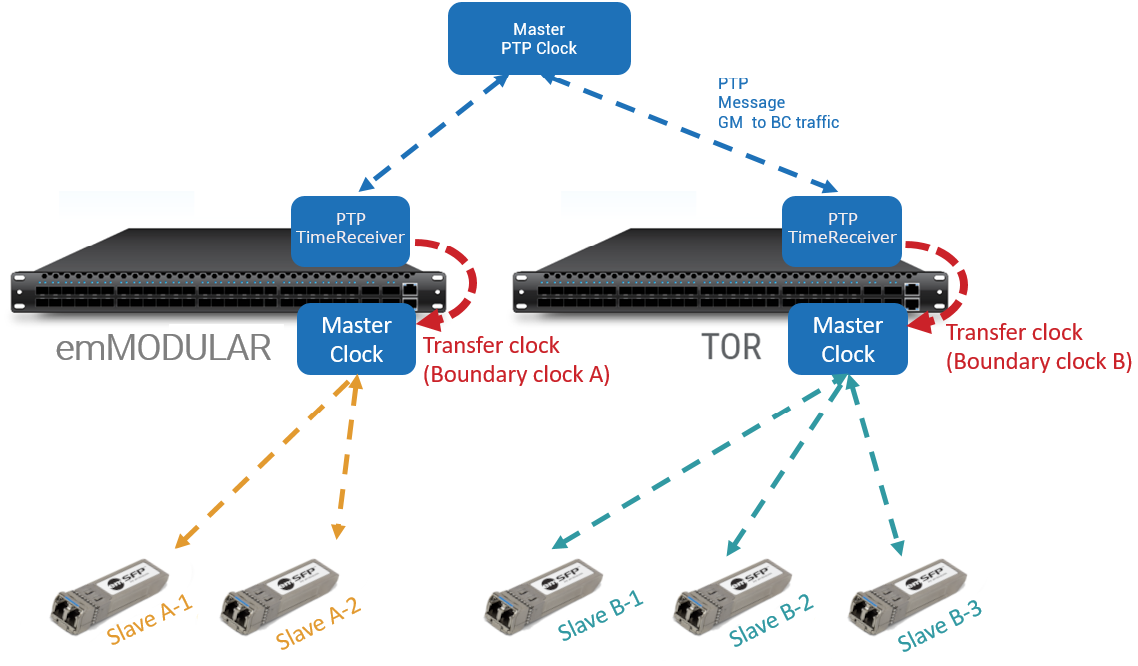
Figure 5. Boundary Clock in Details
Some of the downsides of having the Time Receiver clock directly connected to the Grandmaster include increased workload; limited system scalability and challenges to traffic policing (as some Time Receiver devices might not support a certain type of PTP message mode, Ex: Time Receiver A-2 supports only multicast messages and Time Receiver B-1 supports only hybrid modes).
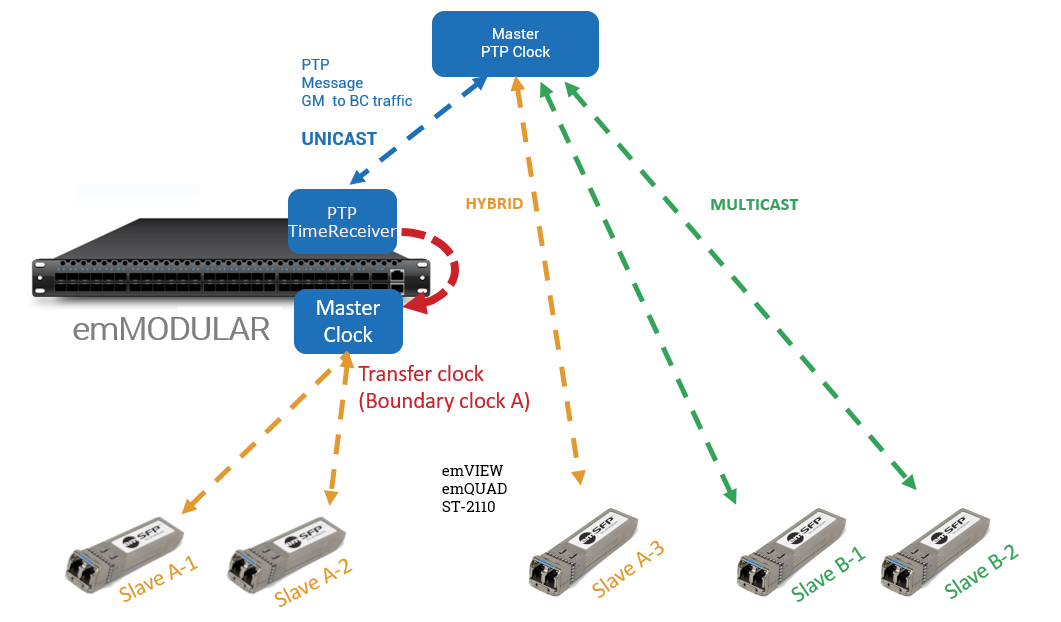
Figure 6. Uncontrolled Time Receiver Clock Connection to Grandmaster
Brief overview of PTP message types:
Unicast: All messages between Time Receiver and Time Transmitter are unicast.
Multicast: All messages between Time Receiver and Time Transmitter are multicast.
Hybrid: All messages are multicast except delay request and delay response messages which are unicast.
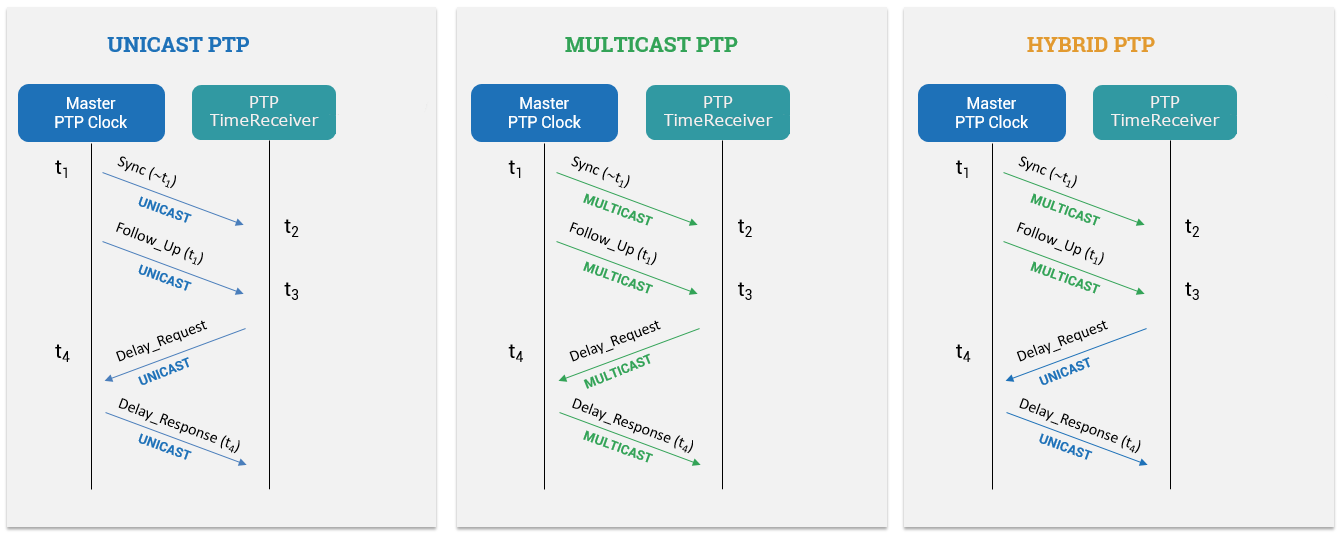
Figure 7. Type of PTP IP Packets Communication: Unicast, Multicast and Hybrid
Take away: Embrionix recommends a Grandmaster-to-boundary clock architecture to improve scalability, reduce traffic load on the Grandmaster, and simplify traffic management across the network.
QOS IMPORTANCE FOR PTP VS. SDI ESSENCE AND MANAGEMENT TRAFFIC
When PTP traffic shares the same physical network as ST 2110 essence streams, it is essential to prioritize traffic by type. PTP packets are significantly smaller and less frequent than essence flows (such as -20, -30, or -40). As a result, if the transmission medium becomes congested, these smaller and less frequent packets are more likely to be dropped unless proper prioritization rules are in place (see Figures 8 and 9).
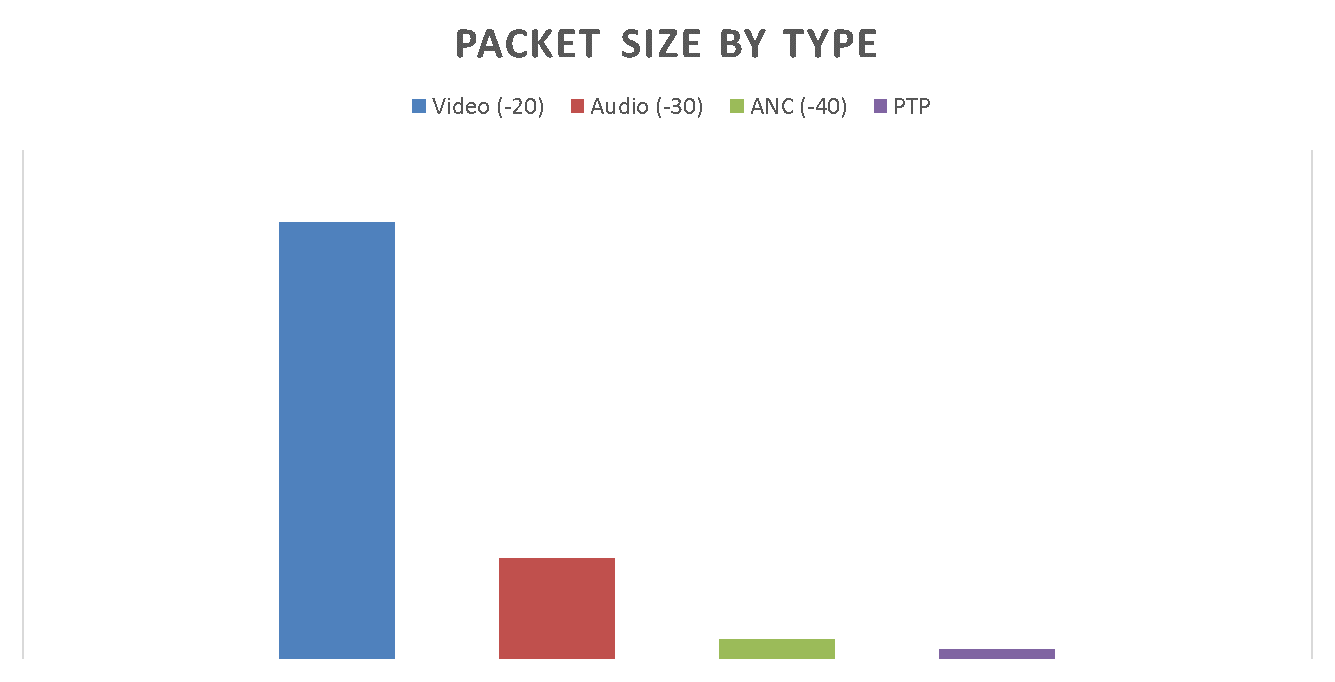
Figure 8: Packet Size Comparison by Type
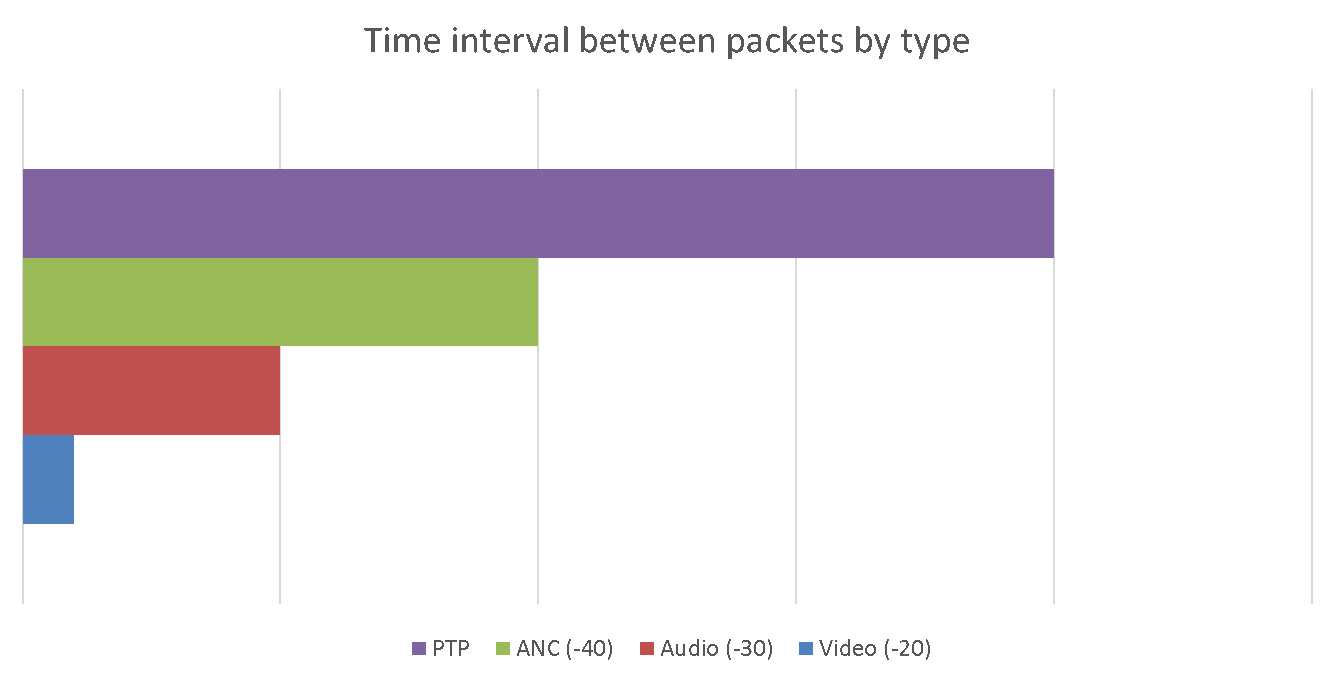
Figure 9: Packet Time Interval Comparison by Type.
Take away: Embrionix recommends prioritizing PTP packets through well-defined policies in high-bandwidth network environments. Embrionix also provides guidance and support in defining and implementing these policy frameworks.
CONCLUSION
PTP is the backbone of any ST2110 deployment
Embrionix recommends the use of a single PTP Grandmaster as a mandatory requirement for any ST 2110 deployment to be considered fully synchronous under the specification. The PTP Grandmaster, together with synchronous sources, is essential for enabling accurate realignment of multiple multi-essence streams. A Grandmaster-to-boundary clock architecture further improves scalability, reduces traffic load on the Grandmaster, and simplifies traffic management and policing.
In an ST 2110 system, receivers must include realignment engines, such as those provided by Embrionix, to ensure that output essences remain properly aligned with each other and with the PTP reference. Since ST 2110 receivers do not support adjustable compensation offsets, it is important to use solutions that incorporate compensation offset capabilities, enabling compatibility with non–Epoch-aware signal generators.
Finally, Embrionix also recommends prioritizing PTP packets through appropriate policies in high-bandwidth network environments.
For more information about our products. Please contact us at Embrionix_Sales@riedel.net
###
About Embrionix
Embrionix, a subsidiary of Riedel Communications, designs and builds innovative, advanced SMPTE video SFPs to close the gap between fiber optic deployments, coaxial deployments, legacy composite deployments, and emerging technologies, such SDI to IP SFPs. By leveraging its core competencies in video broadcast, the company OEMs highly flexible SFP modules (emSFP) to major manufacturers in the industry. Embrionix headquarters are based in Laval, Quebec. Embrionix sales offices, representatives, and distribution offices are located in Canada, United States, United Kingdom, Germany, France, and Japan.
About Riedel Communications
Riedel Communications designs, manufactures, and distributes pioneering real-time video, audio, data, and communications networks for broadcast, pro audio, event, sports, theater, and security applications. The company also provides rental services for radio and intercom systems, event IT solutions, fiber backbones, and wireless signal transmission systems that scale easily for events of any size, anywhere in the world. Riedel is headquartered in Wuppertal, Germany, and employs over 700 people in 25 locations throughout Europe, Australia, Asia, and the Americas.
All trademarks appearing herein are the property of their respective owners.